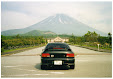
How do you describe a way of life so fundamentally different than ours? “Describe” means putting a bunch of words together
into a logical order. But does that get across how something
looks, what it sounds like, or how it may taste? How can you evoke
these in the reader? Maybe you can’t. Maybe the best you can do is tell a story
and let the audience make of it what they will.
As author of The Beach
Girl, a novelette, and the short story The
Decision Vision, this is what Sid Court hopes to do. He hopes to communicate
what it’s like to not just reside in Japan, but to live in Japan by putting the reader through it’s courses. In service of this, Sid tends to write ambiguously, seeking not clear-cut conclusions that are
satisfying as morals to the story or as story endings, but rather letting the action take its
own ambiguous path.
Certainly life has been ambiguous to the author and the translation warrior. And
herein may lie one of the great lessons of living in Japan: that you can hold your
own views on things, but as long as you do not burden other people with them,
you are remarkably free. However, this approach of theirs calls for formality
in interactions nearly all the time. It takes a lot to get to a frank
expression of the person. But I have known many Japanese people who on the
outside were “typical” but on the inside free-spirited and
“indie”. See? Here I go again, trying to describe rather than
illustrate. Let’s hope Sid does better in his stories.
You can find Sid Court‘s stories on Amazon by following the links below. Please give them a read!
http://www.amazon.com/dp/B07H67ZLFL
http://www.amazon.com/dp/B07G7HWSV7
Saturday, February 23, 2019


Thursday, November 29, 2018
A book about life (and love) in Japan
For those who may be interested, the translation warrior would like to
recommend a book whose story is set in the Japan of the late Showa era (about
the mid- to late eighties). Called The Beach Girl, the story depicts
the day-to-day life of a Japanese-proficient expat in it for the long haul who
is on the verge of entering into an unexpected relationship. And she is a sassy one, that’s for sure.
Portraying the “ordinary” (if such a word can be used to describe anything in Japan), the story avoids clichéd Asian ploys for the westerner’s attention and rejects the sensationalism of the exotic. The translation warrior assures his readers that Japan is an exotic and adventurous enough place without devices like these. This story has adult situations, but maybe that is only natural considering the youthful passionate pursuits of the characters. The protagonist does find himself in a fairly unusual situation, one in which he is poised to learn a lot, if he can stay with it. He is torn and must figure out what to do.
How much the protagonist can speak Japanese is also an interesting topic. He is not 100% fluent like a native speaker, but gets by pretty well with what he knows. Most of the dialogue could be translated into fairly straight-forward Japanese. It might be difficult to find equivalents for a small portion of it, making it a challenge for a translator. Of course, he understands much more than he himself can say, but this is typical of a second language.
Here is the link:
The Beach Girl
Portraying the “ordinary” (if such a word can be used to describe anything in Japan), the story avoids clichéd Asian ploys for the westerner’s attention and rejects the sensationalism of the exotic. The translation warrior assures his readers that Japan is an exotic and adventurous enough place without devices like these. This story has adult situations, but maybe that is only natural considering the youthful passionate pursuits of the characters. The protagonist does find himself in a fairly unusual situation, one in which he is poised to learn a lot, if he can stay with it. He is torn and must figure out what to do.
How much the protagonist can speak Japanese is also an interesting topic. He is not 100% fluent like a native speaker, but gets by pretty well with what he knows. Most of the dialogue could be translated into fairly straight-forward Japanese. It might be difficult to find equivalents for a small portion of it, making it a challenge for a translator. Of course, he understands much more than he himself can say, but this is typical of a second language.
Here is the link:
The Beach Girl
Friday, February 22, 2013
Just a stroll
I feel the concrete of the
Tokyo sidewalk hard against my step. It is concrete like any in the world, yet it
is steeped with the byproducts of Japanese habit and custom and history. I
suppose if I knelt down and sniffed at it, it would smell the same as concrete
anywhere else. But it would be different. Something imperceivable would be in
that smell. Imperceivable, yet I would detect it as an essence rippling through
that part of me that was brought up here.
Thursday, June 14, 2012
The translation warrior cleans up a mess
The translation warrior makes his way to
Takadanobaba to meet a potential client. When did he last get off there? Years
ago, maybe even a couple decades ago, that's when. An interesting station, Waseda
University defines the scene. Fresh young people walk around in clumps or by
themselves. Some could pass for high school freshman in the US. The area itself
has the feel of an older Tokyo: He knows that if he takes the side streets as a
short cut, he may not be seen again for days. So he walks along Waseda Blvd.,
whose sides are crowded by small buildings so close to each other, they are
sometimes hard to distinguish. An occasional modern building looks
sophisticated with its facade of gray shiny panels. His appointment is in one
of those.
Meeting over, the translation warrior
stands outside on the sidewalk. "Now to clean up that mess," he says
to himself. It's been a long time coming, that's for sure. For some reason, instead
of contacting him directly, a client has taken to going through *****. This has
resulted in the unbelievable situation of ***** skimming off some of his work.
The translation warrior even completely missed an opportunity for a job because
***** took it upon ***** to provide the quote, probably with a margin for *****,
and maybe including a price for the DTP work (also the translation warrior's),
and when a competitor offered a lower price, DID NOT NEGOTIATE and turned it
down as TOO CHEAP for *****. All this without authorization from the
translation warrior.
A few words later and the mess is gone.
Dents and scratches remain, but no more clutter. The translation warrior leaves
the building, grim at heart, wondering how long it will last, how far the
message will go, and whether there will be any casualties. Will he be one of
them?
Friday, July 1, 2011
How the translation warrior spent the day, or it spent him
The translation warrior is beat. Not by a dozen pages of kanji, not by hours of worthless meetings, not even by last night's beer, but by getting a re-entry permit. The Yokohama Immigration office has moved. Not only is it farther away, but it's either a bus ride from one station or a thirty-minute walk from another. The translation warrior does not like the bus, so that left the walk. By the way, it's the rainy season with muggy afternoons at 90 degrees.
His trip started at Starbucks, surprising no one that knows him. Half of the lights were off and the air inside warm. When he mentioned the dark, he was told that today being July 1, energy conservation measures were starting. This to make up for the decreased energy output caused by Tepco's clever placement of under-designed nuclear power plants in a tsunami zone. Guess they never thought a big earthquake might happen in a place like Japan.
After sufficient charging by caffeine, he tackled the trek, taking the train first to Nagatsuta, changing there for the train to Yokohama and traveling all the way the bloody hell out to a station called Shinsugita, changing there to the Seaside line, and getting off two stops later at Torihama for a total of an hour and fifteen or so minutes.
The subsequent thirty-minute walk took him through the humidity and by a huge marina packed with yachts. He wondered if many left the dock on weekends, or just served as party platforms. Nothing against that. He passed a lot of factories (poor substitutes for all the elegant little boutiques on the way to Immigration's previous location). Ahead, he could even see freighters gliding between buildings.
Immigration procedures comprised filling in his birthday, passport number, nationality, and everything else for the millionth time in his career in Japan, submitting the application, buying a 6,000 yen revenue stamp to pay the fee, waiting, and then getting his passport back with his new re-entry permit good for three years.
Now back the other way.
By the time he got home, dusk had lowered from the clouds, and evening was settling in. One whole day gone. Good thing there's no work right now.
His trip started at Starbucks, surprising no one that knows him. Half of the lights were off and the air inside warm. When he mentioned the dark, he was told that today being July 1, energy conservation measures were starting. This to make up for the decreased energy output caused by Tepco's clever placement of under-designed nuclear power plants in a tsunami zone. Guess they never thought a big earthquake might happen in a place like Japan.
After sufficient charging by caffeine, he tackled the trek, taking the train first to Nagatsuta, changing there for the train to Yokohama and traveling all the way the bloody hell out to a station called Shinsugita, changing there to the Seaside line, and getting off two stops later at Torihama for a total of an hour and fifteen or so minutes.
The subsequent thirty-minute walk took him through the humidity and by a huge marina packed with yachts. He wondered if many left the dock on weekends, or just served as party platforms. Nothing against that. He passed a lot of factories (poor substitutes for all the elegant little boutiques on the way to Immigration's previous location). Ahead, he could even see freighters gliding between buildings.
Immigration procedures comprised filling in his birthday, passport number, nationality, and everything else for the millionth time in his career in Japan, submitting the application, buying a 6,000 yen revenue stamp to pay the fee, waiting, and then getting his passport back with his new re-entry permit good for three years.
Now back the other way.
By the time he got home, dusk had lowered from the clouds, and evening was settling in. One whole day gone. Good thing there's no work right now.
Monday, November 1, 2010
The translation warrior rants
Once again the translation warrior is baffled by attitudes about quality of English. The Japanese give the judgement of other Japanese unquestioned credence. When the translation warrior asks one of his clients how his judgement of Japanese quality would be received, he gets the "now that you put it that way" routine. This doesn't occur to anyone?
And how many times has he run across arrogant "English specialists", who are committed to lowering English quality with direct translation, enhanced wordiness, and even by insisting on incorrect usage of "a" and "the." All this along with their own peculiar misunderstandings that are so universal they must be taught in school. This plus the intellectual laziness not to look up correct usage when in doubt. Any "little" problems in their own work can be fixed by "native check," that is, having a native speaker of English go over it. But what does that mean? The translation warrior knows what that means. Somebody hired off of the street looks at the translation and tries to fix it so that it reads normally, usually without reference to the original Japanese. Proofing? No. Editing? No. "Native check"? Yes.
Customers readily fall for the same line over and over: "We provide, accurate, fast, and cheap translation." Sure they do. Fast and cheap? Possible. Quality, too? If you believe that, I have a house for you, built fast and cheap. I'm sure it'll still be a fine building in a few years. Otherwise savvy consumers BELIEVE. Why? I don't know. Perhaps this suspension of belief arises from confidence in the ability of non-native speakers to judge their own translation quality: "My writing is good because I say it is." Heard that before? Like those people who tell you they write only good songs, which you stop listening to after the first 15 seconds.
And how many times has he run across arrogant "English specialists", who are committed to lowering English quality with direct translation, enhanced wordiness, and even by insisting on incorrect usage of "a" and "the." All this along with their own peculiar misunderstandings that are so universal they must be taught in school. This plus the intellectual laziness not to look up correct usage when in doubt. Any "little" problems in their own work can be fixed by "native check," that is, having a native speaker of English go over it. But what does that mean? The translation warrior knows what that means. Somebody hired off of the street looks at the translation and tries to fix it so that it reads normally, usually without reference to the original Japanese. Proofing? No. Editing? No. "Native check"? Yes.
Customers readily fall for the same line over and over: "We provide, accurate, fast, and cheap translation." Sure they do. Fast and cheap? Possible. Quality, too? If you believe that, I have a house for you, built fast and cheap. I'm sure it'll still be a fine building in a few years. Otherwise savvy consumers BELIEVE. Why? I don't know. Perhaps this suspension of belief arises from confidence in the ability of non-native speakers to judge their own translation quality: "My writing is good because I say it is." Heard that before? Like those people who tell you they write only good songs, which you stop listening to after the first 15 seconds.
Thursday, October 28, 2010
The translation warrior establishes a new routine
Mornings are not the translation warrior's favorite time of day, but the first cup of coffee makes up for it. Lately he has been having that cup at McDonald's, where he can get it for 120 yen. This satisfies his initial craving to gulp down a bunch, making it easier to slowly sip the next one at Starbucks, where he will spend some time with his portable office, his Toshiba laptop. Starbucks offers a single refill for 100 yen. He enjoys that one after lunch at his favorite yakitori place that serves mackerel in season, broiled over a brazier, and whose master lets him charge up his office. Then it's back to Starbucks for the 100 yen refill, maybe a chocolate chunk scone, and some more work.
Subscribe to:
Posts (Atom)