Sunday, November 1, 2009

Shopping for a Kotatsu

I moved into my first apartment in Japan in September 1983. I still have a copy of my first lease. It was called a "mansion", a word borrowed from English, to distinguish it from regular apaato, another borrowed word. The distinction of it being built of reinforced concrete rather than just wood qualified it for the term. It therefore supposedly had thicker walls for better sound insulation, a misconception my poor neighbors paid for in later years after I bought an electric guitar, and for which I'm paying for now as karma catches up with me.

I visited my old mansion a few months ago, the first time I had seen it in over twenty years. It's now a crumbling building. Unmaintained, it's too dangerous to live in, according to a neighbor lady, who was also concerned about its structural stability in case of an earthquake. Apparently the owner cannot be found, and the police cannot do anything, either.

I looked up at my old room on the corner of the second floor, remembering all the things that happened there that were such a huge part of my adventures in Japan. It was sad to think that it was just a decrepit old room now, probably filled with decaying tatami mats, beat up walls, and rusting pipes. But it was once full of life, a life intense with new and exciting experience. Not many rooms in Japan can say that.

But maybe it's all for the better: I'm quite sentimental; in its current state, there's no longer any reason for me to go back there, as I surely would if it was still thriving.

When I first moved in, I had virtually nothing, except the bare necessities donated to me by kind friends. I'd had to pay ¥500,000 up front as a deposit, six months rent, a figure they had decreased to make it "easier for me to move in". In the Osaka area, such deposits were typical. It had three rooms, arranged linearly. You entered into the kitchen, which had a vinyl floor, then followed straight into the middle and end rooms, both of which were covered in tatami. The rooms were measured in size by the number of tatami mats, each mat 955mm x 1910mm (I had to look this up). The middle room was a four and a half mat room, the end one a six mat room. From the end room, you could walk out onto the veranda, which had hooks for suspending a pole for hanging laundry, something I had yet to buy. I needed a washing machine, too. Dryers were virtually non-existent, and are even now not popular. The feel of naturally sun-dried clothes is still preferred.

Speaking of washing machines, the type available in those days was a simple unit with two basins, one for washing and the other for spin-drying. After the wash cycle finished, you had to move the clothes into the spin-dryer. Also typical of those days, my mansion had no place to set a washing machine inside, so I put it outside next to the entrance, where hoses from the kitchen could reach it, or were there outside faucets? I don't remember now. Nowadays, totally automatic washing machines are most common, but for those who prefer the old system, the old-style units are still available. As was usual in my thinking of those days, I regarded their washing machines as the result of primitive thinking, not of rational choice. I later found out my mistake when a friend stated a firm preference for the dual basin types because of the control they offered. Another moment of enlightenment, of which there were many as I encountered case after case of different ways that had sprung from roots I had never even imagined. This type of experience gradually ground away at my own unconsciously held ideas of cultural superiority, till it finally threatened to reach bare metal, where it has stopped, leaving an equilibrium between tolerance and remnants of smugness.

I've drifted from my story, I see, so back to my old room.

Another piece of equipment lacking in Japanese apartments was a heater. This partly stemmed from a preference for natural air. Even in the dead of winter, families would open all windows and inside doors (the fusuma sliding door) to air out the home. You had to be tough in those days. Heat, when needed, was supplied by a variety of heaters, called stoves. One type was a kerosene stove, which provided not only enough heat for one of the six mat rooms, closed off by fusuma, but also a flat surface for setting a pot to heat water for Japanese green tea. You were on your own outside of that room, though. The toilet room and bath room could be ice cold in winter.

Another means of keeping warm was the kotatsu. This was a low square table the height of a coffee table with a heater fixed to the underside. In winter you lay a thick futon-like quilt over it, then placed a second main table top over this. You then turned on the heater and slipped your legs under the kotatsu, covering your lap with the futon. This could be hard on those of us not used to sitting cross-legged for long periods. Older houses had pits that solved this problem. The kotatsu was placed over this so you could sit with your legs dangling in. The kotatsu made up for low room temperatures, but even in milder seasons, was still the centerpiece for meals and visiting, there usually being no other dining facilities such as table and chairs.

September in Japan is a wonderful season when the summer humidity has finally broke, but the days are still splendidly warm. And Osaka summers were sultry affairs. Still, as the season progressed, the days got cooler. I had an old electric heater among the donations I received, which worked pretty well.

My old heater, which saw use until I
left Japan 23 years after receiving it.

But I also needed a table. And keeping the entire room heated all the time was impractical, as well as expensive, electricity rates being high. So I decided to buy a kotatsu, one of my first purchases of a typical Japanese item, after of course the washing machine and monohoshizao -- the pole for hanging laundry. Those poles are quite long, six feet or more, making them hard to carry if you bought them from a store. I bought mine from an itinerant merchant who carried his stock around in a miniature pickup truck, slowly driving through neighborhoods with his loudspeaker on, through which he blared his presence and wares. I had neither car nor even a 50cc moped at the time, even though I lived a thirty minute walk from the train station (I took the bus in those days), so this was a welcome convenience. I can't remember the last time I saw one of those.

Like Tokyo, Osaka was made up of a bunch of distinct districts, each with a separate character. Honmachi, for instance, was the business district, Namba the nighttime drinking place and haunt of disco goers, and Umeda the center for all the train lines. Another was Nippon Bashi. This district was the electric town because it was where shops that sold electrical goods were concentrated, like Tokyo's more famous Akihabara. I decided to go to Nippon Bashi to find a kotatsu. For the all too rare pleasure of living in the moment, this shopping trip became one of my treasured Japanese memories. There was something about it that stuck with me, maybe something like the feeling you get the first time you swim in warm ocean water.

It was a cool autumn day, not chilly. The sky was gray, but the air clear and transparent like pure stream water on a cloudy day. My friend, who I may have invited because he had a car, and I walked along the Nippon Bashi streets. The shop keepers had set outside for display their goods for sale. We walked from shop to shop, probably looking at such items as raji-cassetttes (compact portable radio-cassette players), stereos, hot water pots, and all manner of appliances, all of a compact design conducive to a full lifestyle in the limited space available in apartments. After all, most students and single people lived in less space than I had, maybe a single six mat room or less! They were pleasing to look at for their perfectly adapted utility. They had a completeness in their unity of purpose. Though slightly different in appearance, according to the manufacturer, all were designed to be attractive and convenient to use. Lines and details were fine, not pumped up, and would enhance any Japanese person or person's room in their use.

We turned a corner. Through the clear fall air wafted a familiar melody. In the crowd of wares on the sidewalk in front of the corner shop, a record player, needle floating and bobbing on a black disk, was playing Gazebo's "I Like Chopin", a big hit at the time, only this was being sung by a female Japanese singer. A faithful but subtly varied arrangement wove between the lyrics vocalized in Japanese by a smooth, faintly sultry voice. Enthralled, I fell in love with the moment and have never forgotten the beautiful melody flavored by the fine touch of Japanese on a cool pastel Japanese autumn day.

I asked who the singer was and was perhaps shown the album cover, or simply told that it was Asami Kobayashi.

I bought a kotatsu from one of the stores, got it home somehow, and used it for years, all the years I was in Japan.

My kotatsu, standing on worn out tatami

Monday, October 12, 2009

117 Coupe

I didn't think I'd buy a car in Japan. I didn't want to pay the parking or the once-every-two-year (or at that time yearly for cars older than ten years) shaken—the safety inspection and road tax that wound up costing over 100,000 yen. On top of that was the 40,000 yen car tax that comes every April. Plus expensive gas. And I didn't think I'd be in Japan long enough to justify all this. Therefore, I bought a car.
 
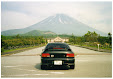
My first was a yellow Isuzu 117 Coupe, a sporty little car with the 1800cc SOHC engine and cool exhaust note. The interior was black vinyl. And no air conditioning. Those hot humid Osaka summers were hell at stoplights. The rest of the time was palatable if you kept the windows open. Pretty sure I paid 300,000 yen for it.


I had a lot of fun driving that car between Osaka and Kobe and up to Rokko-san where all the hot rodders raced around on the curvy roads. I couldn't keep up, of course, and would always let them by, for which they would thank you by flipping on and off their emergency flashers. Hot rodders have the best road manners in Japan.

That car took me to Tokyo and Kyushu. In Kyushu it stopped dead one day. Out in the countryside, of course. Turned the ignition, and nothing happened. My friend and I rolled it down a hill, hoping to start it by popping the clutch. But nothing. We finally gave up, found a phone somewhere, and called a road service called JAF. An hour or so later the guy arrived in his clean truck and neat uniform, opened the hood, and after a quick look said "Oh, what's this?" pointing to a loose wire. What a relief that that was all it was. Unbelievable nowadays, that a car could so easily be repaired.

I stayed at this same friend's house in Kita Kyushu. Upon arriving, because of the narrow road and garage door, he insisted on putting my car in their garage for me and scratched up the rear fender. I still remember his sheepish look. He, of course, insisted also on paying for the body work, but because he was a college student with little money, I didn't have the heart for it and told him we could take care of later. He got out of it, as we shall soon see.

While driving on the expressway on a trip to Tokyo, probably to show off my new 117 Coupe to a friend, a car cut me off just so the young driver and his girlfriend could stare and point at me in their rearview mirror. Fortunately that doesn't happen anymore. But in the Kansai area in those days, I was an oddity.

Well, that car got totaled by a Volkswagen Bug that ran a stop sign, taking out my front end. The driver was in some kind of hurry and missed the sign. Not inconceivable considering how well some of them are hidden. He was also getting married soon, so not wanting any trouble, was compliant about taking the blame. Which, in Japan, also fell on me, as I was informed by the cops when I tried to make my case at the Koban that the fault was his. My crime? Zenpofuchui (前方不注意), or inadequate attention to what was going on ahead of me, a catchall cause attributed to just about anyone in an accident, it seems, except maybe the passengers. Anyway, the fender scratches didn't need repairing anymore. I enjoyed calling my friend to tell him that.

It was a fun little car, and I was sad to lose it. But this other friend who had helped me buy it at his cousin's repair yard also helped get a maximum settlement (of 250,000 yen, was it?) that would set me up for my next car. Yes, another car in Japan. You could go nearly anywhere by train, but not everywhere. In addition, bombing around in the Osaka area was fun. It was said that if you could handle driving in Osaka, you could drive anywhere.

I remember in some of my first outings how nervous I was. When I tried to merge onto a busy road, I could not find an opening and wound up having to stop. Instead of waiting for his turn, the truck behind me went ahead and merged, barreling into the racing traffic that was intimidating me. I knew then I was doing something wrong. After some experience, I finally learned that if an Osaka driver backs off from tailgating the car in front of him for an instant, that's considered being given an opening to merge. Quick reaction is required or else your chance is gone.

Other first experiences included getting hopelessly lost on the expressways, all of which are toll ways, by the way. In one case I was invited to my friend's homestay family's birthday party for one of the daughters. They lived in Moriguchi, about an hour away. I left at around 4:00 pm and arrived at midnight, missing all of the festivities. On my way there, I had somehow entered an expressway. I decided to get off the expressway and ask for directions when I saw the signs for Kyoto soon ahead. I found a fire station by the exit and went in. I asked how to get to Moriguchi from there. Puzzled looks. "Moriguchi? Where?" I was disheartened. They directed me back to Osaka and suggested I ask again when I got close. I no longer remember the order of my endless follies that night, but I circled around so much that I had to get off the expressway and get gas. Finally I gave up and went home, something I was always able to do from no matter where I was. There I called my friend and arranged to meet up with the homestay son-in-law at a location known to both of us, took off, and was there an hour later.

As I write this, I keep remembering other stories. Another time I was to follow a friend's car to Nara. At a key fork in the expressway, they got so far ahead of me in this brand new Nissan 280Z that I lost sight of them. They went on to Nara. I went to Sakai. Again I asked directions, this time at a toll gate after getting off the expressway and turning around. After the repressed laughter, and laudable directions in broken English, I got back home, called somebody, arranged something, but wasn't sure what, and started off again on my own. It was pure luck that the first rest area I happened to stop at had them there waiting for me, to all of our surprise. When we arrived at my friend's brother's place in the hills around Nara, I was told to park down the street in front of their business's office. Trying to show off, I zoomed over there, misjudged braking distance and rammed the office front window, which apparently was strong glass. It didn't shatter, but I was later told that it bowed way in. The look of terror on the brother's wife sitting at the desk behind the window is hard to forget.

But after a while, I did master the roads and the driving. I was addicted.

Thursday, October 1, 2009

Standing on a Sandy Cliff


Standing on a sandy cliff
my face against the wind
lines of white across the blue
roaring in the din.


Twilight promise of the night
the boldest stars begin
to light the swells whose nighttime glow
beckons moonlight kin.


Drawn by whispers of the breeze
the ocean calls from deep within
Alas, I must now turn away
and say good-bye again.


Wednesday, September 30, 2009


Purposeful chatter and half-formed ideas and dreams: Returning students used to college life. New student—any uncertainty subsumed by the excitement of doing new things on their own—being drawn forward into their unknown but anticipated future.
It's been a long time since I left that life. Wandering around on campus, I said hello to a lot of ghosts. **** Hall is no longer a dorm, but I could look up at the window of my old room on the third floor and remember what happened there. I also sat in the lounge of the last dorm I lived in and communed with the ghosts there—different ones, of course.
Later, I thought about how places can make long dormant memories pulsate within you. Like when I visited Osaka for the first time in twenty years: Walking along Shin-Midosuji, I reached an intersection that read "Sonezaki". After I had moved from Osaka, Sonezaki became just a word that I hardly ever even heard. But when I saw the sign, it came back to life and became a place again, one full of experience.
Except that it wasn't quite full. Something was missing.
In each case I was back, but I wasn't. All those memories? They're just ghosts hanging around the place. I've gone on, though sometimes I cannot see that.
So, I think I'll start a blog. It will be written just for me, and sure, anyone else that might drop by and find something they like here. I think it'll contain random musings, some music stuff, maybe a poem or two.
And maybe it'll help me regain a sense of continuity between now and then. I was gone a long time.